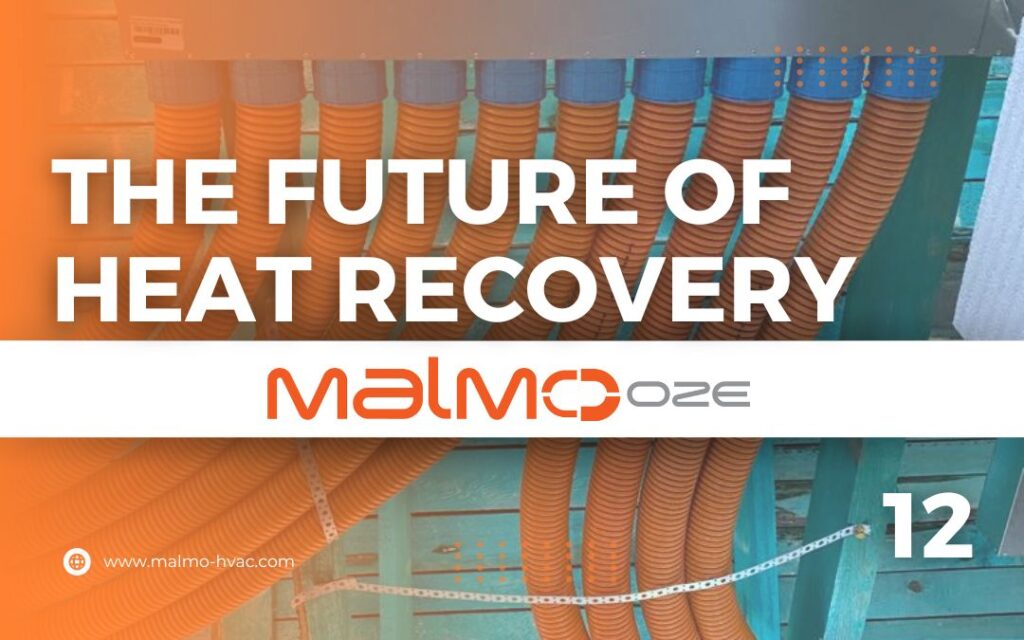
Future of heat recovery seems very promising, specifically in the context of rising ecological awareness, increased pressure on energy efficiency and dynamic technological development. Many factors point out that heat recovery is going to play bigger and bigger roles in the future of buildings and ventilation systems built in them.
Heat recovery development – Key role in the future of buildings.
The European Union is constantly tightening standards concerning energy efficiency of buildings and seeks to reduce its need for thermal energy. Heat recovery is considered as one of key solutions, which contribute to the achievement of these objectives. Because of increasingly lower limits of energy use, buildings are forced to apply more advanced heat recovery systems, which allows for maximum use of recovered heat and minimization of energy loss. Fact that devices seemingly already perfect are still being developed means that this system is needed and will need to work increasingly better. This is evidenced, for example, by the recent invention of a Czech company, which has developed an enthalpy exchanger that operates with an efficiency in heat recovery similar to that of counter-flow exchangers. It’s not a “fly to the moon” yet but it’s definitely a “light bulb”.
Heat recovery in passive buildings
Passive buildings, which are designed and built according to energy demand minimisation assumptions are a perfect example of heat recovery use. Those buildings are equipped with thermal isolation, airtight partitions and efficient systems, which minimize heat loss, but without heat recovery they wouldn’t be able to function. They assure high indoor air quality. Heat recovery is an essential element, which enables achieving high energy efficiency and thermal comfort in this kind of building. Research work and technological development in heat recovery focus on constant improvement of systems and technology. Researchers and engineers look for new materials of high heat recovery efficiency, optimize the performance of heat exchangers and fans, and design more advanced control systems. Because of those actions, we strive for even greater heat recovery efficiency, adaptation to different climatic conditions and increase of user comfort.
Given the direction of technological development and the growing need to save energy, it is anticipated that heat recovery will play an important role in the future of smart and energy sustainable buildings. Intelligent buildings, equipped in advanced systems of energy management, will be able to optimally use the potential of heat recovery to minimize energy use and provide high user comfort.
Future of heat recovery – New technological challenges in energy saving and creating intelligent buildings and energy sustainability.
In summary, the future of heat recovery is promising and full of new, today not yet comprehended by us possibilities. Due to The European Union pressure to decrease demand of buildings for thermal energy and passive buildings development as an example of heat recovery use, those systems are a key solution for energy efficiency and saving. Research and technological development are still going forward, contributing to ever better heat recovery systems, adapted to various climate conditions and building requirements. In the future, heat recovery will play an even more important role in intelligent buildings and energy sustainability, which are the foundation of the future building solutions.